April 8, 2026
Silica ramming mass is one of the most important refractory materials used in induction furnace lining. For steel plants and foundries, the furnace lining is not just a protective layer. It directly affects furnace safety, lining life, melting efficiency, power consumption, downtime, and overall production cost.
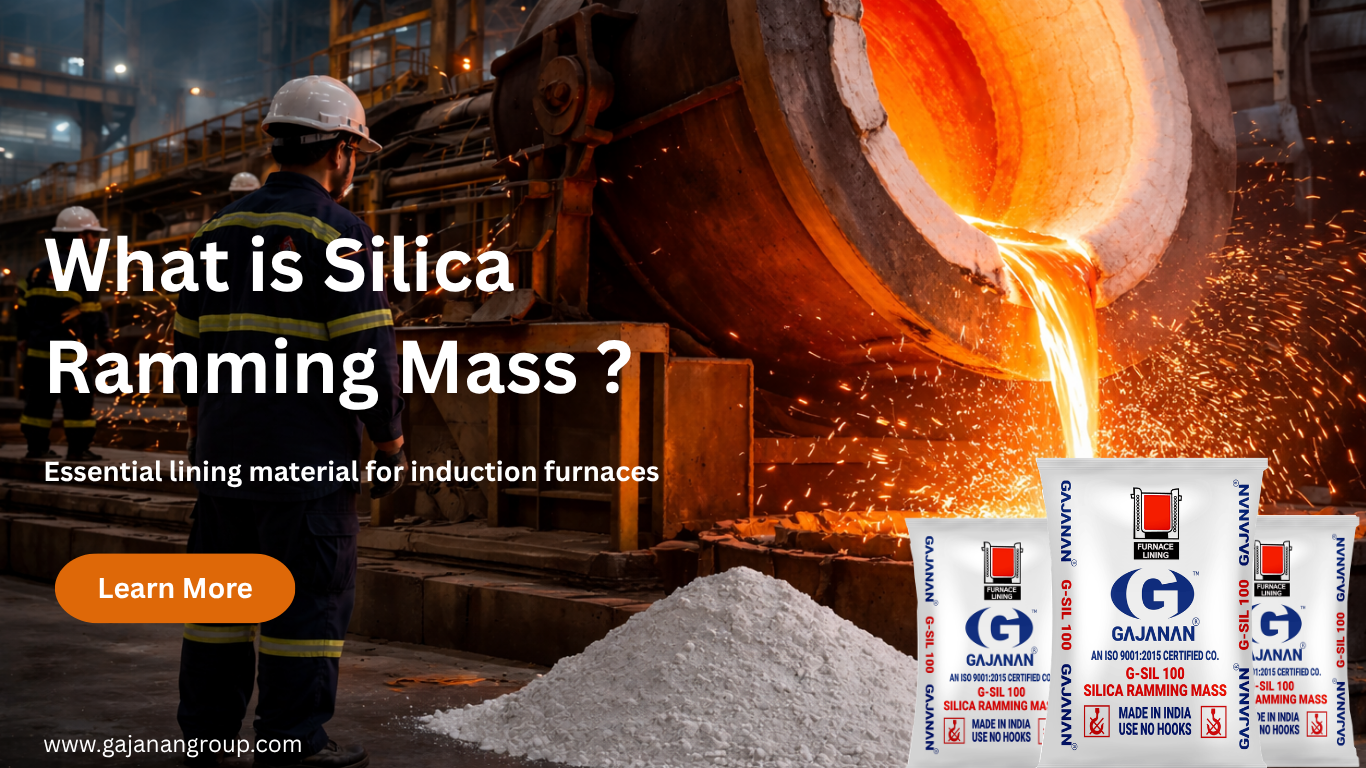
In simple terms, silica ramming mass is a dry refractory mixture made mainly from high-purity silica or quartzite grains. It is rammed inside the induction furnace to form a strong lining between the furnace coil and the molten metal. Once the furnace is heated, the ramming mass undergoes sintering and forms a compact refractory lining that can withstand high operating temperatures.
For any steel plant using an induction furnace, choosing the right silica ramming mass is extremely important. A poor-quality lining material may look cheaper at the time of purchase, but it can lead to early lining failure, metal penetration, furnace shutdowns, safety risks, and higher cost per heat.
At Gajanan Group, silica ramming mass is manufactured with a focus on high-purity raw materials, controlled grain size distribution, low iron content, and consistent batch quality so that steel plants can achieve reliable furnace performance under proper operating conditions.
Silica ramming mass is an acidic refractory lining material used mainly in induction furnaces for melting and holding metals. It is usually made from selected quartzite or silica-based raw materials like quartz that are crushed, graded, and processed into different particle sizes.
The word “ramming” comes from the installation process. The dry material is packed and compacted inside the furnace using manual, pneumatic, or mechanical ramming methods. After installation, the furnace is heated in a controlled manner so that the lining develops strength through sintering.
A good silica ramming mass generally depends on five major factors:
When these factors are controlled properly, the lining becomes more compact, stable, and resistant to thermal stress.
An induction furnace works at very high temperatures. During steel melting, the furnace lining is exposed to molten metal, slag, thermal cycling, mechanical wear, and chemical reactions. The lining has to act as a strong barrier between the molten metal and the furnace coil.
Silica ramming mass is widely used because it provides:
In an induction furnace, even a small weakness in the lining can become a serious issue. If the lining is not compact, if the grain size is not balanced, or if sintering is not done properly, molten metal may penetrate into weak areas. This can reduce lining life and increase the risk of furnace damage.
That is why steel plants should not select silica ramming mass only by looking at the price per tonne. The more practical question is: What is the cost per heat, cost per tonne of steel produced, and reliability of the lining during actual operation?
The furnace lining performs several important functions during melting. First, it protects the furnace coil from direct contact with molten metal. Second, it helps maintain furnace temperature by acting as a refractory barrier. Third, it resists erosion and chemical attack from the metal and slag. Fourth, it gives structural support to the furnace during repeated heating and cooling cycles.
A well-installed silica ramming mass lining usually develops different zones after heating:
This layered structure is important because the furnace lining has to handle both heat and movement. During operation, the lining expands, contracts, and faces repeated thermal cycles. A properly selected silica ramming mass helps the furnace lining remain stable under these conditions.
Ramming mass can broadly be classified into acidic, basic, and neutral types.
Acidic ramming mass is usually silica-based. It is commonly used in induction furnaces where the operating conditions are suitable for acidic lining. Basic ramming mass is usually magnesia-based and is preferred where the slag chemistry is basic. Neutral ramming mass is generally alumina or alumina-magnesia based and is used where higher chemical resistance is required against both acidic and basic conditions.
Silica ramming mass belongs to the acidic refractory category. This is why furnace conditions, slag chemistry, metal grade, temperature, and operating practice must be understood before selecting the lining material. The “best” ramming mass is not the same for every furnace. The best choice is the one that matches the actual application.
A steel plant may face several issues if the ramming mass is not suitable for its furnace.
This may happen because of poor raw material, improper grading, excessive impurities, wrong sintering, or aggressive slag conditions.
Cracks may occur due to thermal stress, poor ramming practice, sudden heating, wrong grain distribution, or improper furnace operation.
If the lining has open pores, weak zones, or poor compaction, molten metal may penetrate into the lining. This is one of the most serious risks in furnace operation.
If the additive is not mixed homogeneously, the lining may sinter unevenly. Some areas may become too glassy, while other areas may remain weak.
Poor-quality ramming mass may reduce lining life and increase relining frequency. This directly increases production cost.
At Gajanan Group, we understand that silica ramming mass is not just a consumable item. It is a critical refractory material that affects furnace performance, safety, and production economics.
Our focus is on manufacturing premium grade silica ramming mass using quality raw materials with updated test reports, controlled processing, proper grading, and consistent quality checks. The aim is to support steel plants with a dependable refractory lining material suitable for induction furnace operations.
Gajanan Group offers different grades of silica ramming mass, including pure ramming mass, boric premix, boron premix, and rock bottom grades. This allows customers to select material based on furnace size, lining area, sintering requirement, and operating conditions.
We also manufacture related refractory products such as Nozzle Filling Compound, Metallurgical Flux, and 90K Mortar, giving steel plants a wider range of refractory and metallurgical support products from one supplier.
Contact Gajanan Group to discuss your silica ramming mass requirement, furnace size, application temperature, and suitable grade selection.
Silica ramming mass is a dry acidic refractory material mainly made from silica or quartzite grains. It is used to line induction furnaces and protect the furnace body from molten metal and high-temperature operation.
Silica ramming mass is mainly used in induction furnaces for steel melting, iron melting, and other foundry applications where acidic lining is suitable.
It forms the furnace lining, protects the furnace coil, resists heat and molten metal attack, and supports safe and efficient melting operations.
In premix silica ramming mass, the sintering aid such as boric acid or boron oxide is already mixed by the manufacturer. In post mix material, the additive is added separately before installation.
Sintering is the heating process through which the ramming mass develops bonding and strength after installation. Proper sintering is important for lining life and furnace safety.
Steel plants should check SiO₂ percentage, Fe₂O₃ level, grain size distribution, binder type, sintering temperature, application temperature, packaging, and supplier consistency.
No. The cheapest material may lead to lower lining life, more downtime, higher patching cost, and greater safety risk. Steel plants should compare the total cost per heat, not only the purchase price per tonne.